This is the website of Qal'at Najm, built by Touristech — a project of JCI Beroea — under the authority of the Directorate-General of Antiquities and Museums and the Ministry of Tourism.
01What it is for
To say what this castle is, and why it is where it is, from the record rather than from memory. Qal'at Najm is described in most places in a paragraph: an Ayyubid castle on the Euphrates near Manbij. That paragraph leaves out the only thing that explains it, which is the crossing, and the only thing that has happened to it recently, which is the lake.
The site is built to stay light. It is meant to be readable on a phone on a Syrian mobile connection, standing on the shore, which is where most people who want it will be.
02Where the facts come from
The base is the dossier on Qal'at Najm prepared by the Directorate of Rural Antiquities, written by آ. زكية عبد الحي, which supplies the registration, the description of the three storeys, the gate, the cisterns, the mosque, the measured contour plan of the mound and the photographs of the interior.
Where the dossier is silent the published record is used: the English and Arabic Wikipedia articles, the Syria Photo Guide, syrian-treasures.com, eSyria for the text of the gate inscription, and North Press for the 2022 repair of the south-eastern wall.
03Where the sources disagree
On a site this little studied they disagree more than you would expect, including about how big the building is. Nothing contested is printed as fact anywhere else on this site. Both readings are set out here.
Which bank of the Euphrates
The Directorate's file says the left bank. English Wikipedia, the Syria Photo Guide and the satellite image inside the file itself all place the castle on the west side of the river. This site says west bank, and avoids the left/right convention, which is read from the direction of flow and is a common source of error.
The sources disagreeHow big the castle is
Arabic Wikipedia gives 95 m north–south by 64 m east–west. eSyria, quoting the researcher Walid Mishu, gives 170 m east–west by 130 m north–south — nearly double, and with the axes the other way round. No dimension for the castle is printed on this site.
The sources disagreeThe ditch
Eight to nine metres wide and seven deep, according to Arabic Wikipedia and syrian-treasures.com. Twenty-five metres wide and five deep, according to eSyria. The first pair is given on the ditch's page because two independent sources agree on it; the second is recorded here.
The sources disagreeHow high above the river
Four sources agree on about 68 metres, and that is the figure the site uses. The Directorate's file instead gives 160 feet above the surrounding ground and 275 above river level — roughly 49 and 84 metres.
The sources disagreeWho Najm was
The Directorate's file names him as نجم غلام جني الصفدي, a commander of Marwan ibn Muhammad, the last Umayyad caliph, and credits him with building the castle. Nothing found in the published record outside the file corroborates the man. The site reports it as what the authority's file says, attributed to the file.
The sources disagree04Photographs
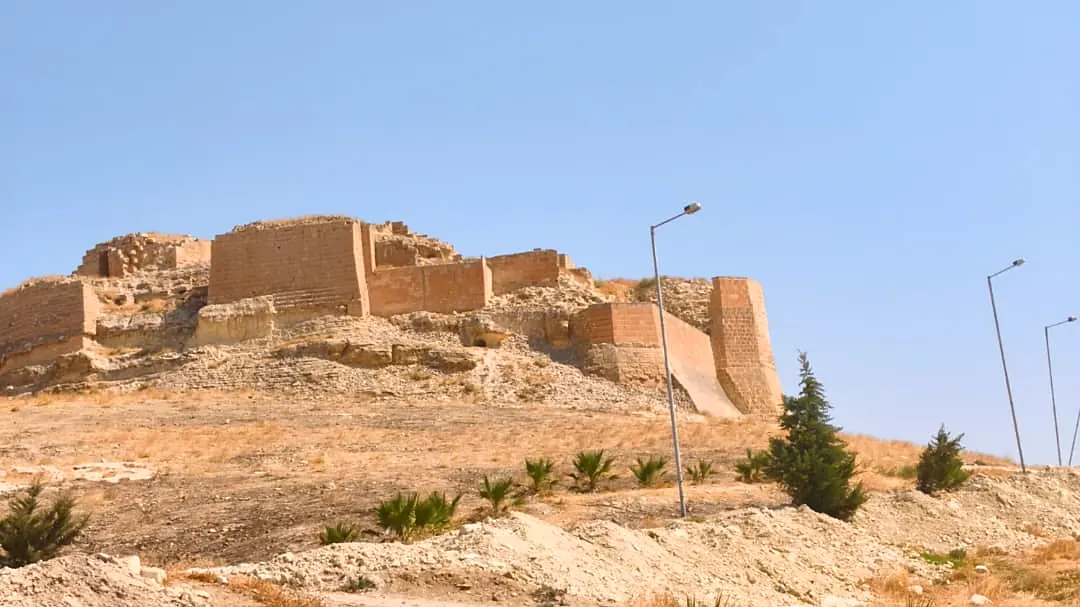
Every photograph on this site comes from one of two places, and each is credited under the picture. The modern views of the castle, the shore and the lake were made for this project. The interiors, the inscription, the mihrab and the measured contour plan are the Directorate's, from the dossier.
Four of the thirteen parts of the castle have no photograph here — the bent entrance, the bath, the towers of the gate and the hanging stair. The dossier's set almost certainly contains them, but it does not say which frame is which, and a caption is a claim. They stay unillustrated until someone who was there can name them.
One image was considered and rejected: a 1934 photograph from the Institut français du Proche-Orient catalogued as Qal'at Najm. The catalogue title records where the survey was working, not what is in the frame, and the frame contains a carved block in a field with a man standing behind it for scale. There is no castle in the picture and the block cannot be identified, so it is not used.