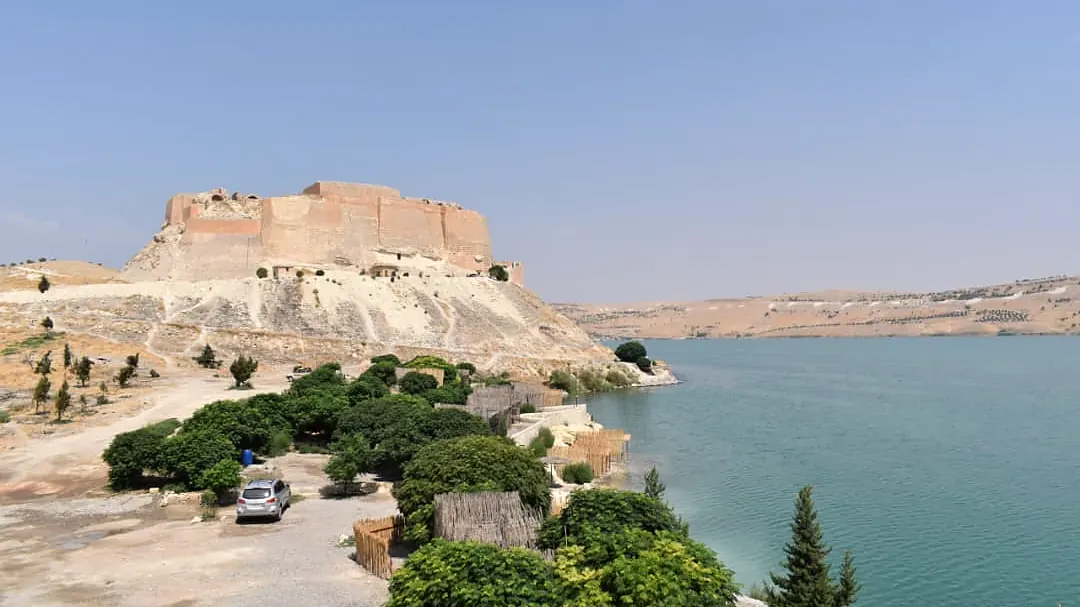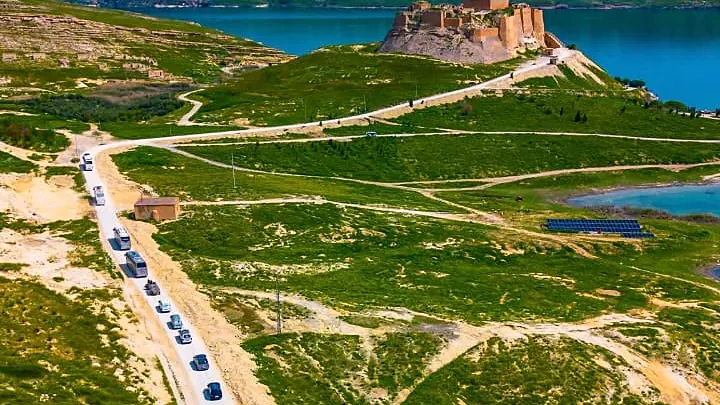
Qal'at Najm does not stand alone, and it was never meant to. It is the river gate of Manbij, about thirty kilometres to its west, and it only makes sense as part of that city's reach.
01Manbij
Manbij is old in a way that is easy to underestimate. The Greeks called it Hierapolis — the sacred city — and before that it was Mabbug. It held one of the most famous temples in the ancient Near East, that of the goddess Atargatis, whose cult drew pilgrims from across Syria and which a Greek writer of the second century described at length in a treatise called On the Syrian Goddess.
A city of that standing on the edge of the steppe needs its crossing controlled, and the crossing is here.
02The Euphrates
The river is the reason for all of it. The Euphrates is the western edge of the Jazira, the frontier between the Syrian steppe and Upper Mesopotamia, and for most of recorded history it has been a boundary that armies had to negotiate rather than a road they could follow. The places where it could be crossed were therefore worth more than the land around them, and they were fortified accordingly — Qal'at Najm here, Qal'at Ja'bar downstream, Jarabulus and Carchemish upstream.
Al-Zahir Ghazi took Manbij, Qal'at Najm and Qal'at Ja'bar in a single campaign in 1202. That is not three conquests. That is one: the river.
03In the same programme
Qal'at Najm is one of four Syrian heritage sites published in this series, alongside the Citadel of Aleppo, the Great Umayyad Mosque of Aleppo and the church of Saint Simeon Stylites.